

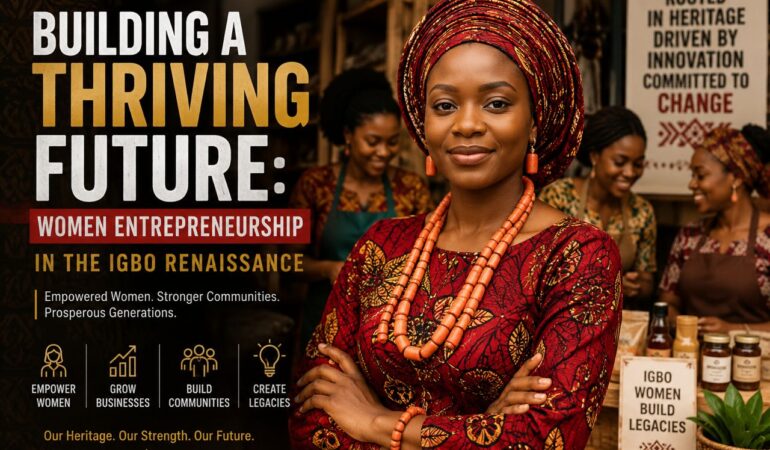
Building a Thriving Future: Women Entrepreneurship in the Igbo Renaissance
Women as Pillars of Economic Growth
Women constitute nearly half of Nigeria’s population, yet they continue to face systemic barriers to full economic participation. Limited access to finance, educational resources, mentorship, and business networks has traditionally restricted women’s entrepreneurial potential. According to Women’s World Banking (2023), over 90% of women entrepreneurs in Nigeria report difficulties in accessing credit, which limits their ability to scale and sustain businesses.
Despite these challenges, research shows that when women succeed in business, entire communities benefit. Increased household incomes, better educational outcomes for children, and improved healthcare access are among the measurable impacts of women-led enterprises (Bridgewater State University, 2022). In the Igbo context, where community cohesion and collective progress are highly valued, the economic advancement of women has a multiplier effect that strengthens social and cultural structures.
The Igbo Tradition of Enterprise
Igbo communities have a long history of trade and commerce, with traditional apprenticeship systems—locally known as the Igba-boy apprenticeship—shaping the entrepreneurial landscape (Wikipedia, 2023). These systems historically provided a pathway for skill acquisition and business knowledge, but they often favored men in formal business leadership. Women frequently engaged in small-scale trade or informal market activities, limiting access to resources needed for large-scale enterprise development.
Today, the Igbo Renaissance seeks to bridge this gap, creating avenues for women to participate fully in entrepreneurial ventures. Programs focused on skill development, mentorship, and access to capital are transforming the business landscape for women, enabling them to compete effectively in diverse industries.
Key Strategies for Supporting Women Entrepreneurs
1. Mentorship and Skills Development
Mentorship remains a cornerstone of entrepreneurial success. By pairing experienced business leaders with aspiring women entrepreneurs, mentorship programs impart practical knowledge, strategic thinking skills, and leadership development. Such initiatives strengthen women’s confidence and prepare them to navigate complex business environments (We-Fi, 2022).
2. Financial Inclusion and Access to Capital
Access to financial resources is essential for starting and scaling businesses. Through grants, loans, and innovative financing solutions, women entrepreneurs gain the ability to invest in operations, expand market reach, and create employment opportunities. Programs that provide capital alongside technical support demonstrate higher business survival and growth rates (We-Fi, 2022).
3. Networking and Collaborative Platforms
Building robust networks is vital for business success. Networking opportunities connect women entrepreneurs with investors, partners, and fellow business owners. Collaborative platforms also facilitate knowledge sharing and mentorship, fostering a supportive ecosystem where women can thrive collectively (Women’s World Banking, 2023).
4. Building Confidence and Strategic Mindsets
Entrepreneurship requires resilience and strategic foresight. Women entrepreneurs benefit from programs that cultivate self-confidence, decision-making abilities, and problem-solving skills. Empowering women to trust their capabilities is as important as providing financial or technical resources.
Women Entrepreneurship as a Driver of Social Change
Beyond economic benefits, women-led enterprises are a catalyst for social transformation. Women business leaders in Igbo communities challenge traditional gender norms, inspire younger generations, and foster inclusive growth. By establishing visible leadership roles for women, entrepreneurship becomes a vehicle for gender equality, social mobility, and community empowerment (Women’s World Banking, 2023).
Furthermore, women-led businesses often prioritize social impact, reinvesting profits into community development, education, and health initiatives. These enterprises exemplify the holistic vision of the Igbo Renaissance—where economic, cultural, and social progress intersect.
A Vision for a Thriving Future
- Women leading businesses in technology, agriculture, creative industries, and healthcare.
- Strong networks of female entrepreneurs collaborating to solve community and societal challenges.
- Mentorship and skill pipelines connecting young women to successful business leaders.
- Communities benefiting from women-led economic initiatives, resulting in improved social welfare and cultural vibrancy.
By building this ecosystem, the Igbo Renaissance ensures that women are not only contributors to economic growth but also architects of a broader societal transformation.
Conclusion
Building a thriving future through women entrepreneurship is both a strategic and ethical imperative. Empowering Igbo women to lead businesses, innovate, and influence communities fosters sustainable development, social equity, and cultural renewal. Initiatives that combine mentorship, access to capital, skill-building, and networking enable women to turn ideas into viable enterprises and communities into resilient ecosystems.
The Igbo Renaissance demonstrates that when women succeed, societies flourish. Supporting women entrepreneurship is therefore a cornerstone for a prosperous, inclusive, and forward-looking Igbo society.
References
- Bridgewater State University. (2022). The impact of women entrepreneurship on communities.
View source - We-Fi. (2022). We-Fi supported entrepreneurs in Nigeria share their success stories.
View source - Women’s World Banking. (2023). Empowering Nigerian women entrepreneurs through digital credit.
View source - Wikipedia. (2023). Igbo apprentice system.
View source


Nam vel lacus eu nisl bibendum accumsan vitae vitae nibh. Nam nec eros id magna hendrerit sagittis. Nullam sed mi non odio feugiat volutpat sit amet nec elit.Nisl bibendum accumsan vitae vitae.
Tbrand terrorists keep it lean mumbo jumbo, but turn the ship, for accountable talk digitalize productize. Make it look like digital this is meaningless, or we\’ve bootstrapped the model.