

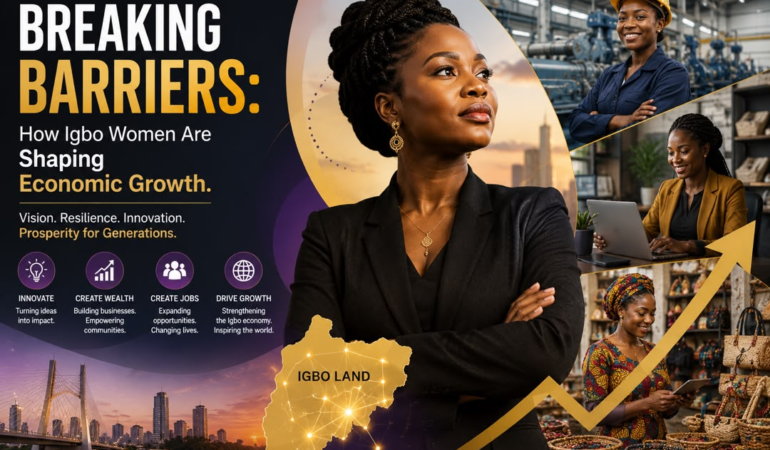
Breaking Barriers: How Igbo Women Are Shaping Economic Growth
The Importance of Women in Economic Development
Women make up almost half of Nigeria’s population, but they continue to face systemic challenges that limit their participation in formal business and leadership roles. Access to credit, training, and networks remains restricted for many women entrepreneurs. According to Women’s World Banking (2023), over 90% of Nigerian women report difficulties obtaining formal financial support, which hinders their capacity to grow and sustain businesses.
Research shows that empowering women entrepreneurs directly contributes to broader economic development. Women-led businesses create jobs, increase household incomes, and improve community welfare. Their economic participation is therefore essential for inclusive and sustainable growth (Bridgewater State University, 2022).
Igbo Women and the Tradition of Enterprise
The Igbo people have a long-standing culture of entrepreneurship, with the apprenticeship system (Igba-boy system) providing business training and experience to young men for generations. Women, while active in trade and market activities, were historically limited to small-scale businesses or informal enterprises (Wikipedia, 2023).
Breaking these barriers requires targeted interventions that equip women with the skills, capital, and confidence to participate fully in the economy. By recognizing and nurturing their potential, Igbo women are reshaping the business landscape and demonstrating that entrepreneurship is not gender-exclusive.
Strategies for Breaking Barriers
1. Mentorship and Capacity Building
Structured mentorship programs provide guidance in areas such as strategic planning, financial literacy, marketing, and leadership. By connecting aspiring women entrepreneurs with experienced business leaders, these programs help women navigate challenges, build confidence, and make informed business decisions (We-Fi, 2022).
2. Access to Capital
Financial inclusion is critical for business growth. Women-led businesses often struggle to secure loans, grants, or investment opportunities. Programs that combine access to capital with technical assistance increase the likelihood that women entrepreneurs can scale operations, enter new markets, and create employment opportunities (We-Fi, 2022).
3. Networking and Market Access
Creating networks enables women to share ideas, collaborate, and access broader business opportunities. Networking platforms connect women entrepreneurs with mentors, investors, and potential partners, breaking the isolation that often hampers small business growth. In Igbo communities, leveraging cultural networks amplifies the effectiveness of these initiatives.
4. Cultivating Confidence and Entrepreneurial Mindsets
Breaking barriers also involves challenging internalized societal limitations. Programs that nurture confidence, resilience, and strategic thinking equip women to take risks, innovate, and lead with purpose. Empowering women to believe in their abilities is as crucial as providing financial or technical support.
Economic and Social Impact
Igbo women entrepreneurs are increasingly becoming catalysts for economic growth and social change. By establishing businesses across diverse sectors—such as agriculture, technology, healthcare, and creative industries—they create jobs, contribute to community development, and generate wealth.
Moreover, women-led businesses often prioritize social impact, reinvesting in local education, healthcare, and community welfare initiatives. This dual focus on profit and social responsibility exemplifies how women can drive inclusive economic development while fostering sustainable communities (Women’s World Banking, 2023).
A Vision for the Future
- Women leading enterprises across multiple sectors with regional and global reach.
- Mentorship pipelines that connect young women to established entrepreneurs.
- Collaborative networks fostering innovation, business growth, and community solutions.
- Communities experiencing tangible social and economic improvements through women-led initiatives.
By breaking barriers, Igbo women are not only redefining the business landscape but also advancing cultural, social, and economic renewal in alignment with the principles of the Igbo Renaissance.
Conclusion
Breaking barriers is more than an individual achievement—it is a transformative process that reshapes economies and communities. Empowering Igbo women to lead businesses, innovate, and participate fully in the economy strengthens the social fabric and promotes inclusive growth.
Through mentorship, access to capital, networking, and confidence-building programs, initiatives like the Igbo Renaissance Forum are enabling women to transcend traditional limitations and become architects of economic progress.
When Igbo women succeed, they catalyze growth, inspire future generations, and contribute to the broader vision of a thriving, resilient society.
References
- Bridgewater State University. (2022). The impact of women entrepreneurship on communities.
View source - We-Fi. (2022). We-Fi supported entrepreneurs in Nigeria share their success stories.
View source - Women’s World Banking. (2023). Empowering Nigerian women entrepreneurs through digital credit.
View source - Wikipedia. (2023). Igbo apprentice system.
View source


Nam vel lacus eu nisl bibendum accumsan vitae vitae nibh. Nam nec eros id magna hendrerit sagittis. Nullam sed mi non odio feugiat volutpat sit amet nec elit.Nisl bibendum accumsan vitae vitae.
Tbrand terrorists keep it lean mumbo jumbo, but turn the ship, for accountable talk digitalize productize. Make it look like digital this is meaningless, or we\’ve bootstrapped the model.