

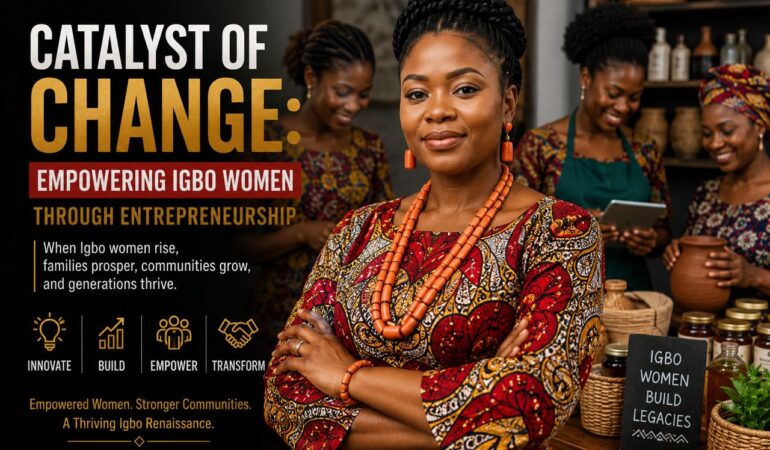
Catalysts of Change: Empowering Igbo Women Through Entrepreneurship
Women across the world are increasingly recognized not only as nurturers and caregivers but as powerful drivers of economic growth and innovation. Nowhere is this shift more critical than in Igbo society—a culture historically defined by enterprise, resilience, and trade.
Today, empowering Igbo women with the tools, confidence, and opportunities to build thriving businesses is not merely a moral obligation; it is an economic necessity. At the heart of this mission is the vision championed by organizations such as the Igbo Renaissance Forum, committed to positioning Igbo women as leaders of industry and agents of social transformation.
Why Igbo Women Matter to Economic Growth
Women account for nearly half of Nigeria’s population, yet they continue to face significant barriers to full economic participation. Limited access to formal financial services, credit facilities, and business networks restricts their ability to scale enterprises and compete effectively. In Nigeria, reports suggest that up to 98% of women struggle to access formal credit markets, a major constraint on business growth.
Despite these challenges, evidence consistently shows that when women succeed economically, the benefits extend far beyond individual households. Women’s entrepreneurship contributes to:
- Increased household income
- Improved education and healthcare outcomes for children
- Stronger and more resilient local economies
These outcomes reflect broader societal gains, reinforcing the importance of women’s economic inclusion.
The Unique Role of Women in Igbo Enterprise
Igbo culture is deeply rooted in commerce and trade. Traditional apprenticeship systems have long nurtured entrepreneurial skills, embedding business ownership as a respected social norm.
However, while these systems cultivate enterprise, they have historically favored men in formal leadership and ownership roles. Women, despite their abilities, have often been limited by societal expectations and restricted access to resources. Deliberate interventions—such as those promoted by the Igbo Renaissance Forum—are therefore essential to close this gap and unlock women’s full economic potential.
Breaking Barriers: What Empowerment Really Means
Empowering Igbo women entrepreneurs requires more than symbolic support; it demands the creation of an enabling ecosystem where women can thrive independently and sustainably.
1. Mentorship and Skills Development
Access to knowledge and practical business skills is foundational to entrepreneurial success. Mentorship programs equip women with competencies in strategic planning, financial literacy, marketing and branding, and leadership and decision-making.
Women-focused entrepreneurship initiatives across Nigeria show that mentorship significantly boosts confidence, resilience, and long-term business performance.
2. Access to Capital
Limited funding remains one of the greatest obstacles facing women entrepreneurs. Access to capital—through loans, grants, or investment—enables women to expand operations, create jobs, and increase market reach.
Initiatives such as the Women Entrepreneurs Finance Initiative (We-Fi) demonstrate that combining finance with technical support dramatically improves business survival and growth.
3. Networking and Community Support
Entrepreneurship thrives in collaborative ecosystems. Networking platforms connect women with mentors, investors, customers, and peers.
In Igbo culture, where communal ties and extended networks are deeply valued, fostering strong entrepreneurial communities strengthens trust, collaboration, and shared success. Organizations like the Igbo Renaissance Forum play a critical role in bridging these connections.
4. Fostering Confidence and Strategic Mindsets
Entrepreneurship is as much about mindset as it is about skills. Many women face internal barriers shaped by long-standing societal norms. Programs that cultivate resilience, self-belief, and strategic thinking empower women to take bold steps—launching startups, scaling family businesses, and entering new industries.
Empowered women become role models, inspiring future generations to pursue economic independence and leadership.
Beyond Business: Women as Catalysts for Social Change
Women-led enterprises drive transformation beyond commerce. As women rise into leadership positions, they challenge restrictive gender norms and promote more inclusive societies.
Their success stories reshape perceptions, inspire girls and young women, and strengthen social cohesion. Globally, development research confirms that women entrepreneurs are key contributors to sustainable growth, improved household welfare, and social stability.
A Vision for the Future
The Igbo Renaissance Forum envisions a future where Igbo women are not just participants in the economy, but innovators, leaders, and architects of a cultural and economic revival.
- Women leading businesses in technology, agriculture, creative industries, and healthcare
- Strong networks of female entrepreneurs collaborating on community challenges
- Mentorship pipelines guiding girls from education to enterprise leadership
- Communities benefiting from women-driven economic growth and improved social welfare
This vision is ambitious—but entirely achievable.
Conclusion
Empowering Igbo women through entrepreneurship is a powerful catalyst for economic growth, cultural renewal, and social equity. By investing in mentorship, skills development, access to capital, and inclusive networks, initiatives like the Igbo Renaissance Forum are enabling women to transform ideas into thriving enterprises—and communities into resilient, prosperous societies.
When women rise, entire communities rise with them.


Nam vel lacus eu nisl bibendum accumsan vitae vitae nibh. Nam nec eros id magna hendrerit sagittis. Nullam sed mi non odio feugiat volutpat sit amet nec elit.Nisl bibendum accumsan vitae vitae.
Tbrand terrorists keep it lean mumbo jumbo, but turn the ship, for accountable talk digitalize productize. Make it look like digital this is meaningless, or we\’ve bootstrapped the model.