
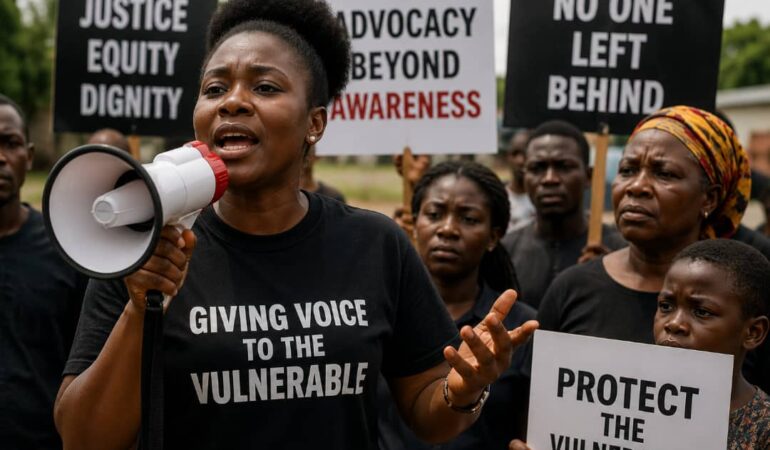
Giving Voice to the Vulnerable: Advocacy Beyond Awareness
In many societies, injustice persists not only because of deliberate abuse of power, but also because those most affected lack the voice, knowledge, or platforms to speak for themselves. Silence—whether imposed by fear, ignorance, or exclusion—often becomes the greatest ally of oppression. For Ndi Igbo, whose heritage places high value on dialogue, participation, and communal responsibility, such silence contradicts both cultural ethics and human dignity.
The Igbo Renaissance Forum (IRF) recognizes that true human rights advocacy must go beyond awareness as an abstract concept. It must actively give voice to the vulnerable, empower communities with knowledge, and transform public consciousness into civic action. Through human rights education, community outreach, and public enlightenment, the Forum works to ensure that no Igbo voice is silenced and no injustice remains unseen.
“The most common way people give up their power is by thinking they don’t have any.”
— Alice Walker
Silence as a Tool of Injustice
Silence is rarely neutral. In the context of human rights, it often signals fear, marginalization, or lack of access to information. Many victims of discrimination and abuse remain unheard because they do not know their rights, distrust institutions, or fear retaliation. Others are excluded by social, economic, or political structures that deny them participation.
In Igbo society, voice has traditionally been a marker of belonging. Village assemblies, family councils, and age-grade meetings provided spaces where concerns could be raised and resolved collectively. When individuals were silenced, the community itself was weakened. The Igbo Renaissance Forum draws inspiration from this heritage, recognizing that restoring voice is essential to restoring justice.
“When people are denied the right to speak, they are denied the right to exist fully.”
— Arundhati Roy
Human Rights Education as Empowerment
Knowledge is the foundation of empowerment. Without understanding their rights and responsibilities, individuals are vulnerable to exploitation and manipulation. Human rights education is therefore a central pillar of the Igbo Renaissance Forum’s advocacy strategy.
Through workshops, seminars, publications, and digital platforms, the Forum works to demystify human rights and make them accessible to everyday people. These efforts are designed not only to inform, but to inspire confidence and agency. When individuals understand their rights, they are better equipped to recognize violations, seek redress, and participate meaningfully in civic life.
Education also fosters responsibility. Rights are strengthened when communities understand that protecting dignity and equality is a shared duty, not the sole responsibility of institutions.
“An educated, enlightened and informed population is one of the surest ways of promoting the health of a democracy.”
— Nelson Mandela
Community Outreach: Meeting People Where They Are
Advocacy cannot be effective if it remains distant from the people it seeks to serve. The Igbo Renaissance Forum emphasizes community outreach as a means of bridging the gap between policy and lived reality. By engaging directly with communities—both urban and rural—the Forum ensures that advocacy is grounded in real experiences.
Outreach initiatives include town hall engagements, cultural forums, youth dialogues, and collaborations with community leaders. These spaces allow individuals to share concerns, ask questions, and collectively explore solutions. They also help the Forum identify emerging issues and tailor advocacy efforts to specific contexts.
In Igbo tradition, progress is achieved through collective dialogue. Outreach revives this tradition by turning advocacy into a conversation rather than a one-sided message.
“If you want to know what people need, listen to them.”
— African Proverb
Public Enlightenment and Cultural Reorientation
Beyond individual education, societal attitudes play a significant role in enabling or preventing human rights violations. Harmful norms, stereotypes, and misconceptions often normalize abuse and exclusion. Public enlightenment challenges these narratives by reshaping how communities understand rights, dignity, and responsibility.
The Igbo Renaissance Forum uses media engagement, cultural programming, and public discourse to promote values of equality, justice, and inclusion. By framing human rights within Igbo cultural values, the Forum counters the misconception that rights are foreign concepts detached from local realities.
When communities see human rights as an extension of their own moral traditions, they are more likely to defend them.
“Culture is the widening of the mind and of the spirit.”
— Jawaharlal Nehru
Awareness as a Tool for Prevention
Awareness is not an end in itself; it is a tool for prevention. When individuals and communities are informed, they are less likely to tolerate abuse or remain silent in the face of injustice. Awareness creates vigilance, and vigilance creates accountability.
The Igbo Renaissance Forum views awareness as a protective shield. By equipping people with knowledge and platforms to speak, the Forum reduces the conditions that allow violations to occur unchecked. In this sense, advocacy saves not only those who have already suffered injustice, but also those who might otherwise become victims.
“The price of apathy towards public affairs is to be ruled by evil men.”
— Plato
Strengthening Civic Participation
Giving voice to the vulnerable also means strengthening civic participation. Democracy and development are weakened when large segments of society are excluded from decision-making processes. Human rights advocacy must therefore encourage active citizenship and engagement.
Through civic education and advocacy campaigns, the Igbo Renaissance Forum empowers individuals to engage with institutions, demand accountability, and contribute to public life. This participation transforms communities from passive recipients of policy into active shapers of their own future.
“The future of democracy depends on the participation of its citizens.”
— Kofi Annan
From Awareness to Action: A Collective Renaissance
Advocacy beyond awareness is about transformation—transforming silence into speech, fear into confidence, and marginalization into participation. For the Igbo Renaissance Forum, giving voice to the vulnerable is both a moral obligation and a strategic necessity.
Rooted in Igbo heritage and guided by universal human rights principles, the Forum continues to build a culture where every voice matters and every life counts. When the vulnerable are heard, communities grow stronger, institutions become more accountable, and society moves closer to justice.
“The arc of the moral universe is long, but it bends toward justice.”
— Martin Luther King Jr.
By amplifying silenced voices and turning awareness into action, the Igbo Renaissance Forum affirms a simple truth: a people who speak together can change their destiny together.

Nam vel lacus eu nisl bibendum accumsan vitae vitae nibh. Nam nec eros id magna hendrerit sagittis. Nullam sed mi non odio feugiat volutpat sit amet nec elit.Nisl bibendum accumsan vitae vitae.
Tbrand terrorists keep it lean mumbo jumbo, but turn the ship, for accountable talk digitalize productize. Make it look like digital this is meaningless, or we\’ve bootstrapped the model.