

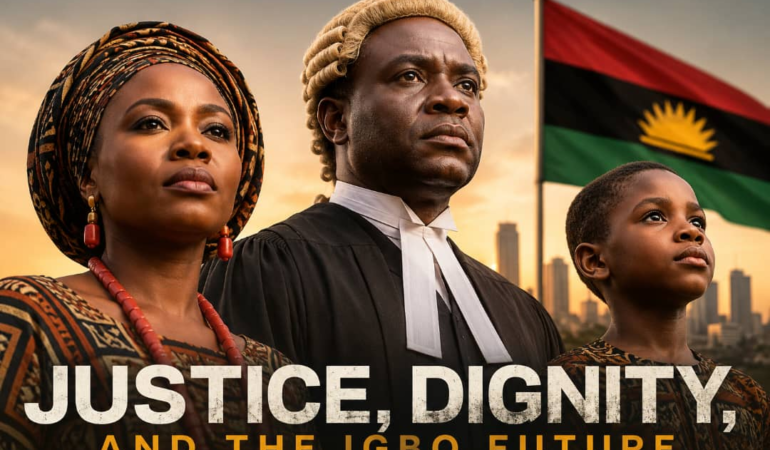
Justice, Dignity, and the Igbo Future
Justice and dignity are not abstract ideals; they are lived realities that shape how individuals and
communities experience freedom, opportunity, and belonging. For Ndi Igbo, whose history reflects both
remarkable resilience and profound challenges, the pursuit of justice is inseparable from the defense
of human dignity. The Igbo Renaissance Forum (IRF) is founded on this understanding—championing
fundamental human rights as the bedrock of a just, inclusive, and prosperous Igbo future.
Across generations and geographies, Igbo identity has been sustained by values of fairness,
accountability, and collective responsibility. Whether at home or in the diaspora, Ndi Igbo continue
to seek a society where equality before the law is guaranteed, justice is accessible, and governance
serves the people. The Igbo Renaissance Forum places these principles at the center of its advocacy,
recognizing that without justice, development is hollow, and without dignity, progress is incomplete.
“Justice is the constant and perpetual will to allot to every man his due.”
— Aristotle
Justice as the Foundation of a Just Society
Justice is the cornerstone upon which peaceful and stable societies are built. When laws are applied
fairly and institutions function transparently, individuals develop trust in the system and confidence
in their future. Conversely, when justice is selective or inaccessible, it breeds alienation,
resentment, and instability.
The Igbo Renaissance Forum understands justice not merely as punishment for wrongdoing, but as a
system that ensures fairness, protects rights, and resolves disputes without discrimination. Advocacy
efforts focus on confronting abuses of power, challenging discriminatory practices, and promoting
respect for due process—especially in contexts where Igbo communities have faced marginalization.
In traditional Igbo society, justice was administered through communal structures that emphasized
truth, restitution, and reconciliation. While modern legal systems differ in form, the underlying
principle remains the same: justice must be impartial and accessible to all.
“The strength of a society is measured by how justly it treats its weakest members.”
— Adapted from John Rawls
Equality Before the Law: A Non-Negotiable Right
Equality before the law is a fundamental human right and a defining feature of democratic societies.
It affirms that no individual or group is above the law, and no one is beneath its protection. For Ndi
Igbo, both within Nigeria and across the diaspora, equality before the law remains a critical concern.
Disparities in law enforcement, judicial access, and administrative fairness undermine confidence in
institutions and erode social cohesion. The Igbo Renaissance Forum advocates for legal systems that
uphold equal treatment regardless of ethnicity, gender, socioeconomic status, or geographic location.
Equality before the law is not simply about fairness in courtrooms; it extends to equal access to
public services, protection from discrimination, and the right to seek redress without fear or
prejudice. Where equality is denied, dignity is diminished.
“The law must be equal for all, or it is justice for none.”
— Legal Maxim
Accountability in Governance
Governance that lacks accountability inevitably compromises justice and dignity. When leaders and
institutions operate without transparency, power is easily abused and rights are often violated. The
Igbo Renaissance Forum recognizes accountability as a vital safeguard for human rights and democratic
integrity.
Through advocacy, public engagement, and collaboration with civic institutions, the Forum promotes
governance systems that are responsive to the people they serve. Accountability ensures that public
officials answer for their actions and that policies reflect the needs and rights of citizens.
In Igbo cultural thought, leadership is a trust bestowed by the community, not a license for unchecked
authority. This perspective reinforces the Forum’s call for ethical leadership grounded in service,
responsibility, and respect for human dignity.
“Power tends to corrupt, and absolute power corrupts absolutely.”
— Lord Acton
Dignity as the Core of Human Rights
Human dignity lies at the heart of all human rights. It affirms the inherent worth of every individual,
regardless of status or circumstance. When dignity is respected, people are empowered to participate
fully in social, economic, and political life.
The Igbo Renaissance Forum frames dignity as both a moral value and a practical imperative. Protecting
dignity means opposing discrimination, resisting dehumanization, and ensuring that policies and
practices uphold the humanity of all. It also means standing with those whose dignity has been
violated, offering pathways to justice and restoration.
In Igbo worldview, the dignity of the individual is bound to the dignity of the community. An affront
to one is an affront to all—a principle captured in the proverb onye aghana nwanne ya (no one
should be left behind).
“Human dignity is not negotiable. It is inherent.”
— Vaclav Havel
The Igbo Diaspora and the Global Pursuit of Justice
Ndi Igbo are a global people, contributing to societies across continents. Yet, members of the
diaspora often face unique challenges, including discrimination, exclusion, and barriers to justice.
The Igbo Renaissance Forum extends its advocacy beyond national borders, recognizing that dignity and
rights must be protected wherever Igbo people reside.
By engaging with international human rights organizations and global platforms, the Forum elevates
local concerns to international attention. This global engagement reinforces solidarity and ensures
that the experiences of Ndi Igbo inform broader human rights conversations.
“Human rights are universal and know no borders.”
— United Nations Principle
Building the Igbo Future Through Justice
The future of Ndi Igbo depends on the strength of institutions, the fairness of systems, and the
protection of dignity. Justice is not a destination, but a continuous process that requires vigilance,
participation, and moral courage.
The Igbo Renaissance Forum envisions a future where young people inherit societies governed by law,
communities bound by respect, and institutions accountable to the people. This vision is grounded in
both Igbo heritage and universal human rights principles.
“The best way to predict the future is to create it.”
— Peter Drucker
Conclusion: A Call to Collective Responsibility
Justice, dignity, and the Igbo future are deeply interconnected. Defending human rights today lays the
foundation for inclusive development, social harmony, and sustainable progress tomorrow. The Igbo
Renaissance Forum calls on individuals, communities, and institutions to embrace their collective
responsibility in building a just society.
When justice is accessible, dignity is protected, and governance is accountable, Ndi Igbo can thrive
with confidence and pride—both at home and across the diaspora. In this shared commitment lies the true
essence of an Igbo renaissance.
“A just society is one where dignity is not demanded, but guaranteed.”
— Igbo Renaissance Forum


Nam vel lacus eu nisl bibendum accumsan vitae vitae nibh. Nam nec eros id magna hendrerit sagittis. Nullam sed mi non odio feugiat volutpat sit amet nec elit.Nisl bibendum accumsan vitae vitae.
Tbrand terrorists keep it lean mumbo jumbo, but turn the ship, for accountable talk digitalize productize. Make it look like digital this is meaningless, or we\’ve bootstrapped the model.